
Skip to content
USE CASE · MODERNIZE

Rescue a legacy platform without freezing delivery

Modernize business-critical systems in governed missions. Engyn maps dependencies, plans bounded changes, generates refactors and tests, and ships reviewed work — without shutting down the roadmap.

MODERNIZE · ENGYNmission
§ 01 · Overview
§ 02 · Problem
§ 03 · Why current approaches fail
§ 04 · How Engyn works
§ 05 · Mission workflow
§ 06 · Agent roles
§ 07 · Governance & audit
§ 08 · Business outcomes
Govern · Map · Measure~64%
governed-mission fig_legacy-modernization
// AT A GLANCE

A governed modernization mission

  1. 01Map the legacy estate and its risk
  2. 02Scope a bounded modernization mission
  3. 03Refactor with generated regression tests
  4. 04Review evidence and approve the change
  5. 05Release incrementally to the ledger
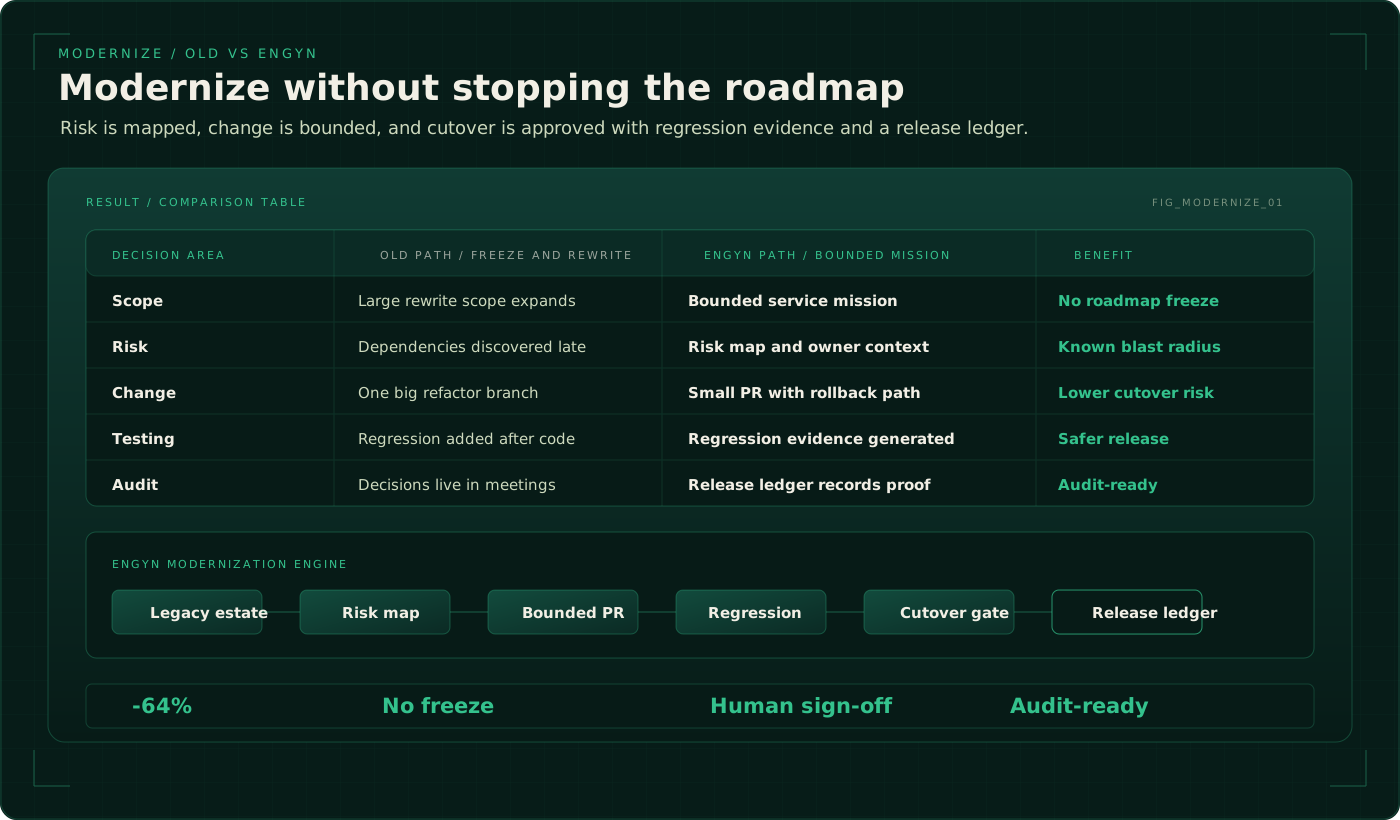
Old freeze-heavy modernization path compared with Engyn bounded modernization path using risk maps, regression evidence, cutover approval, and release ledger.
Old vs Engyn comparison - freeze-heavy modernization versus a bounded mission that preserves delivery motion.
−64%
Cost per modernization task
No freeze
Incremental cutover
Human sign-off
On high-risk services
Audit-ready
Release-ledger evidence

Illustrative modeled outcome. Not a verified customer result unless supported by approved evidence.

From the outside, delivery looks faster. Inside Engyn, every step is planned, governed, reviewed, tested, and signed off before release.

// HOW IT WORKS

The governed mission, end to end.

A legacy capability enters as a mapped modernization mission. Agents isolate risk, refactor with evidence, and route the cutover through human approval.

Evidence console · Estate to release ledger

A governed modernization mission with risk and proof visible

blast radius mapped / cutover gated
01 / Inputs + mission frame
Legacy service
source system
Dependency graph
blast radius
Change objective
bounded scope
Mission frame

Engyn turns modernization into a contained change with system mapping, rollback notes, owner context, and explicit approval before cutover.

02 / Agent workbench
DiscoveryArchitectureRefactorRegressionComplianceRiskReleaseLedger
Quality gates
G1 Risk map approved
G2 Rollback captured
G3 Regression pass
G4 Cutover signed
03 / Evidence + decision
Refactor PR
bounded diff
ready
Risk score
service impact
current
Release ledger
audit trail
recorded
Human decision

Humans approve cutover after reviewing blast radius, tests, rollback plan, risk notes, and ledger evidence.

§ 01

Overview

Modernize business-critical systems through governed, incremental missions — refactor, test, review, and release without stopping the roadmap.

~64% lower cost per modernization task

Illustrative modeled outcome. Not a verified customer result unless supported by approved evidence.

Who it is for
Financial-services technology leadersCTOs and CIOsEngineering directorsEnterprise architectsQA leadersHeads of change & release in regulated environments
§ 02

Problem

Large legacy platforms carry business-critical risk, but teams cannot stop feature delivery long enough to rewrite them. The roadmap and the modernization mandate compete for the same engineers.

Pain points
  • Release freezes during major change
  • Tightly coupled code and unclear service boundaries
  • Regression fear on every touch
  • Incomplete dependency knowledge
  • Documentation drift from the running system
  • Audit effort concentrated at the very end
§ 03

Why current approaches fail

  • Big-bang rewrites create unacceptable business risk and rarely land on time.
  • Manual modernization planning is slow and hard to keep current as the system changes.
  • Testing is deferred too late to influence design decisions.
  • Review evidence lives scattered across tickets, chat, spreadsheets, and CI logs.
  • Teams cannot prove exactly what changed, why, and who approved it.
§ 04

How Engyn works

Engyn ingests the current system, decomposes change into bounded missions, proposes strangler-style refactor paths, drafts implementation tasks and tests, routes work through policy-aware review gates, and records approvals and release evidence as one continuous delivery story.

§ 05

Mission workflow

  1. 01 Intake the legacy service or modernization objective
  2. 02 Map the dependency graph and bounded-context candidates
  3. 03 Define mission scope and acceptance criteria
  4. 04 Generate the refactor plan and code deltas
  5. 05 Generate regression, API, and data-integrity tests
  6. 06 Collect evidence and produce a risk score
  7. 07 Human technical and release approvals
  8. 08 Append a release-ledger entry and deploy incrementally
§ 06

Agent roles

Discovery Agent

Inventory and domain mapping across the legacy estate.

Architecture Agent

Target-state design and incremental cutover planning.

Refactor Agent

Code transformation and adapter / façade scaffolding.

QA Agent

Regression and API coverage generation for changed domains.

Compliance Agent

Evidence completeness and policy conformance checks.

Release Agent

Release notes, ledger entries, and deployment packaging.

§ 07

Governance & audit controls

Governance, audit, QA & release controls
  • Policy-based mission definition
  • Approval checkpoints before merge and before release
  • Traceability from mission → change set → test evidence
  • Rollback notes attached to every change
  • Risk tiering by service criticality
  • Immutable release-ledger entry per cutover
  • Environment and test-run provenance
  • Required human sign-off on high-risk services
§ 08

Business outcomes

  • Lower cost per modernization unit
  • Smaller blast radius per change
  • Faster lead time for safe change
  • Better audit readiness
  • Reduced release-window anxiety
  • A clearer, living modernization roadmap
Before

A payment or onboarding monolith requires a freeze window, a cross-team dependency meeting, manual regression spreadsheets, and late-stage sign-off.

After

A bounded service change runs as one mission with generated test assets, evidence attachments, approval records, and a controlled cutover path — leaving the rest of delivery moving.

// RELATED

Related use cases.

// MODERNIZE

Rescue a legacy platform without freezing delivery

Modernize business-critical systems through governed missions — refactored, tested, reviewed, and released without ever freezing the roadmap.