
Skip to content
USE CASE · SCALE

Roll AI delivery across the org

Standardize AI-assisted software delivery across teams with governance, audit, permissions, cost controls, and reporting built in from day one.

SCALE · ENGYNmission
§ 01 · Overview
§ 02 · Problem
§ 03 · Why current approaches fail
§ 04 · How Engyn works
§ 05 · Mission workflow
§ 06 · Agent roles
§ 07 · Governance & audit
§ 08 · Business outcomes
Govern · Map · Measure12
governed-mission fig_ai-delivery-at-scale
// AT A GLANCE

A governed rollout mission

  1. 01Set the enterprise governance baseline
  2. 02Create reusable mission templates
  3. 03Assign permissions and model routing
  4. 04Launch teams and measure outcomes
  5. 05Expand with shared knowledge
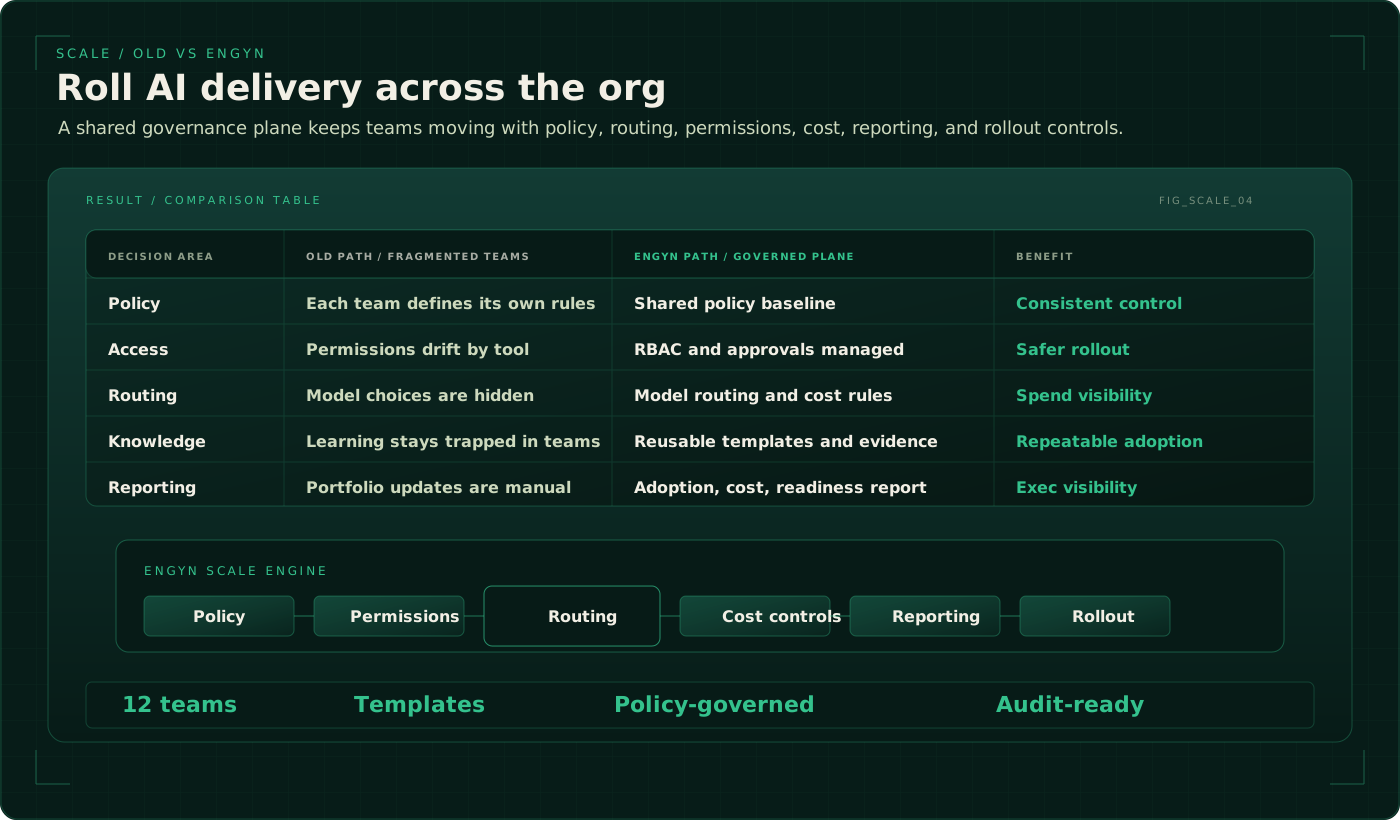
Old fragmented AI adoption path compared with Engyn shared governance path for policy, routing, permissions, cost, reporting, and rollout.
Old vs Engyn comparison - fragmented team-by-team AI adoption versus one governed delivery plane.
12 teams
Illustrative scale marker
Templates
Repeatable rollout
Policy-governed
Permissions & routing
Audit-ready
Logs & approvals

Illustrative modeled outcome. Not a verified customer result unless supported by approved evidence.

From the outside, delivery looks faster. Inside Engyn, every step is planned, governed, reviewed, tested, and signed off before release.

// HOW IT WORKS

The governed mission, end to end.

A governance baseline enters once. Engyn turns it into team templates, model routing, evidence capture, and portfolio reporting for controlled expansion.

Evidence console · Governance to team rollout

A portfolio console for governed AI delivery at scale

policy active / rollout measured
01 / Inputs + mission frame
Governance baseline
rules + risk
Team templates
repeatable missions
Tool policy
routing + access
Mission frame

Engyn gives every team the same policy, permissions, model routing, cost controls, and reporting structure while preserving local delivery context.

02 / Agent workbench
PolicyRBACRoutingKnowledgeCostReportingAdoptionAudit
Quality gates
G1 Policy approved
G2 Permissions set
G3 Budget routed
G4 Adoption reported
03 / Evidence + decision
Adoption report
team readiness
live
Cost controls
routing + budget
active
Expansion plan
next teams
planned
Human decision

Leaders expand rollout only after reviewing team readiness, usage evidence, cost controls, policy adherence, and audit visibility.

§ 01

Overview

Standardize AI-assisted software delivery across teams with governance, audit, permissions, cost controls, and reporting built in from day one.

12 teams onboarded

Illustrative scale marker. Not a verified customer result unless supported by approved evidence.

Who it is for
CTOs and CIOsTransformation leadersHeads of engineeringQA leadersPlatform teamsPMO and operating-model leadersEnterprise architecture stakeholders
§ 02

Problem

Organizations often have multiple AI pilots, multiple copilots, and multiple model providers — and no shared control plane for delivery risk, spend, or evidence.

Pain points
  • Tool sprawl across teams
  • Inconsistent prompts and workflows
  • Unclear agent permissions
  • Duplicated effort and budget surprises
  • Weak auditability
  • Tension between central control and team autonomy
§ 03

Why current approaches fail

  • Purely local experimentation does not scale.
  • Purely centralized control becomes a delivery bottleneck.
  • Model and tool choices proliferate without policy.
  • Knowledge stays trapped in isolated chats.
  • Teams cannot compare outcomes or prove compliance.
§ 04

How Engyn works

Engyn provides a shared delivery operating model: standard mission templates, role-aware agent permissions, model-routing rules, approval policies, knowledge memory, spend controls, and executive reporting — while teams still execute work in domain-specific missions.

§ 05

Mission workflow

  1. 01 Define the enterprise governance baseline
  2. 02 Configure model and permission policies
  3. 03 Onboard pilot teams with standard mission templates
  4. 04 Collect evidence, usage, and spend data
  5. 05 Refine guardrails and reporting
  6. 06 Expand by business unit or product line
  7. 07 Run continuous optimization and governance review
§ 06

Agent roles

Governance Agent

Policy and risk-pack administration.

Template Agent

Mission blueprints and reusable workflows.

Workspace Agent

Team setup, permissions, and environment scaffolding.

Knowledge Agent

Shared memory, reusable artifacts, and retrieval quality.

Cost Control Agent

Spend visibility and budget thresholds.

Reporting Agent

Portfolio dashboards and adoption tracking.

Delivery Coach Agent

Rollout guidance, maturity scoring, and onboarding.

§ 07

Governance & audit controls

Governance, audit, QA & release controls
  • Role-based access and least privilege
  • Model allowlists and routing policies
  • Approval requirements for sensitive actions
  • Cost caps and usage alerts
  • Prompt and artifact retention policy
  • Audit logs for agent activity
  • Exception workflow for policy overrides
  • Release and quality requirements inherited from team templates
Enterprise rollout phases
01Foundation

Governance baseline, security and model policies.

02Pilot

Pilot teams onboarded; mission templates created.

03Expansion

Shared knowledge integration; reporting and cost controls.

04Scale

Business-unit rollout; continuous optimization.

§ 08

Business outcomes

  • Faster onboarding of new teams
  • Lower governance overhead per team
  • Better spend predictability
  • Less duplicated experimentation
  • More consistent quality and release practices
  • Stronger executive visibility
Before

Teams independently buy tools, save ad hoc prompts, and cannot explain which models were used for which delivery decisions — or what those decisions cost.

After

Teams use approved mission templates, agent permissions, model routing, shared evidence patterns, and executive reporting while still working inside their own delivery domains.

// RELATED

Related use cases.

// SCALE

Roll AI delivery across the org

Standardize AI-assisted delivery across every team — with governance, audit, cost control, and reporting built in from day one.